Yesterday I woke up lost amongst the usual five horsemen of the artist’s apocalypse: money, envy (permanent), ambition (too much), success (lack of), and inspiration (misplaced). It felt like leaving the atmosphere of one of the busy rooms from the art college I attended twenty years ago, a week before the final show: musty portacabins, semi-permanent, dusty anxiety, stressful artistic negotiations — zero confidence in the work and zero money in the bank, insecurities lodged deep in a plastic alleyway of institutional semi-permanence.
Lying there, staring at the ceiling, I became fixated on the fear that I lack a central idea — that I don’t have a structure strong enough to hold my work together. That this absence might explain my uneasy sense of failure. My thoughts drifted into a long hall of past artworks. Moving through them, I realised they weren’t arranged in time but in space. Some were finished, some abandoned, some only ever existed as fragments — and remained fragments. Each occupied a room in the architecture of my mind: a bizarre, semi-permanent interior where every work I’ve made, imagined, or discarded still resides. This imagined environment slips between places and eras — the romantic lounges of early eighteenth-century France, downtown New York in the early 1980s, English castles in the 1500s — not as references exactly, but as atmospheres.
I had an idea: maybe I had come up with a new way of working, or at least thinking about work that is not using a studio in the literal sense, and it is not about focusing on a finished body of work. It is the act of building an imagined space that exists before any single artwork is made. A mental environment where ideas gather: materials, scale, research, practical constraints, possible contexts of display, and my own self-imposed (stretchable) timelines. The building doesn’t dictate how the work looks. It dictates how work comes into being. Ideas go in — work comes out. The process is what’s repeated, not the outcome.
The works that emerge from this space may differ wildly from one another, because they are made in relation to a shared internal structure rather than as isolated objects. The building contains everything: a research library, a workshop, and a provisional exhibition space held together in the imagination. Ideas can be tested, rearranged, or abandoned before they solidify into objects, and no single work is forced to carry the entire weight of judgement on its own.
This imagined architecture is not fixed. It shifts as research accumulates, ideas are tested, or circumstances change. Holding it in mind early offers a way of navigating the unstable lifespan of a body of work. Decisions about form, material, concept, and direction are like the soft furnishings in each room; they are made in dialogue with a larger structure rather than in isolation. The larger structure is the practical elements of making the work and, in this scenario, becomes the foundations and walls of the building.
For individual artists in the real world, studios, galleries, museums, and audiences provide a concrete version of this foundational structure. Galleries offer cultural position, physical exhibition space, and economic framework. These structures do an enormous amount of invisible labour — far more than they are often credited for. They are not neutral containers for work but engines that generate audience, capital, and lifestyle. They ‘midwife’ the work coming into the world.
When an artist lacks access to this infrastructure, the work does not disappear — but the labour multiplies. Everything the gallery would normally hold becomes another job to be imagined, organised, paid for, and sustained. Time slows. Progress fragments. The artist must construct not only the work, but the conditions under which the work might exist.
This is where the imagined architecture becomes essential rather than indulgent. Without external structures, the internal building expands. It becomes detailed enough to hold context, audience, judgement, and completion. It grows vertically, then spiritually. What began as a workspace becomes something closer to a cathedral: a place where belief, doubt, and evaluation circulate.
For example, many galleries bring an audience. Whoever they show will get an audience. Often the illusion artists live under is that their work is good because of the size of the audience they seem to bring, but the gallery’s reputation often brings it. The gallery could show almost anyone and the audience would come. This can snowball: the audience convinces itself of the artist’s genius and buys work on that basis, and on and on — and this is how the emperor gets his clothes.
The audience varies with medium. For musicians there is direct reaction — there is clapping. For fine artists there is no such audience. There are whispers and comments, reviews of which there are remarkably fewer these days. There is the private view, but even there everyone is a potential liar. Everyone is polite, and for very good reason: most people in the room are artists, and they know what it took to make the work. They are going to be kind. Most of the time the work is witnessed by a single silent spectator. There is no audience — certainly not a ticket-buying one, unless you are a dead artist. Just one or two people, briefly. Surely a fantastic imaginary congregation is better than this.
So without this reception, without this stage, how do artists gauge their work? If it is not through a publisher, not through critics, and only partially through an imagined audience, then who decides? How do they know what they are making is good? How do they learn, adjust, and move on?
They can try to compare themselves to other artists, but it is never within the same framework. Artists with blue-chip galleries operate at a completely different scale — it is like comparing playing at a village fête to playing at Glastonbury. They can compare themselves to so-called comparable artists, but that too quickly becomes a mystery. Where does that other person’s money come from? A trust fund? Sales? A secret job? The conditions are opaque, the metrics unreliable.
There is only one place left for the artist to gauge their work: inside their newly consecrated imaginary cathedral. Here they can find their answers, because all the answers have already been built into the space itself — into the pillars, the pulpits, the glass windows, the arches, the decorated ceilings. Once the questions have been bounced around the space long enough, the final and most important one inevitably emerges: when is the work finished?
Eventually the cathedral becomes a complete world, with its own limits and deadlines. Work is finished by returning to the original plans drawn up at the start. Once complete, it is documented, stored, and laid to rest—either in the long corridor of other works, just a foot away from the red velvet carpet running down the centre of the hallway, or in a panelled room, or in a polished concrete box. Or perhaps it’s put out the back in an epicly huge cemetery. I lie there, wondering. Any minute now I’ll get up. Any minute now.
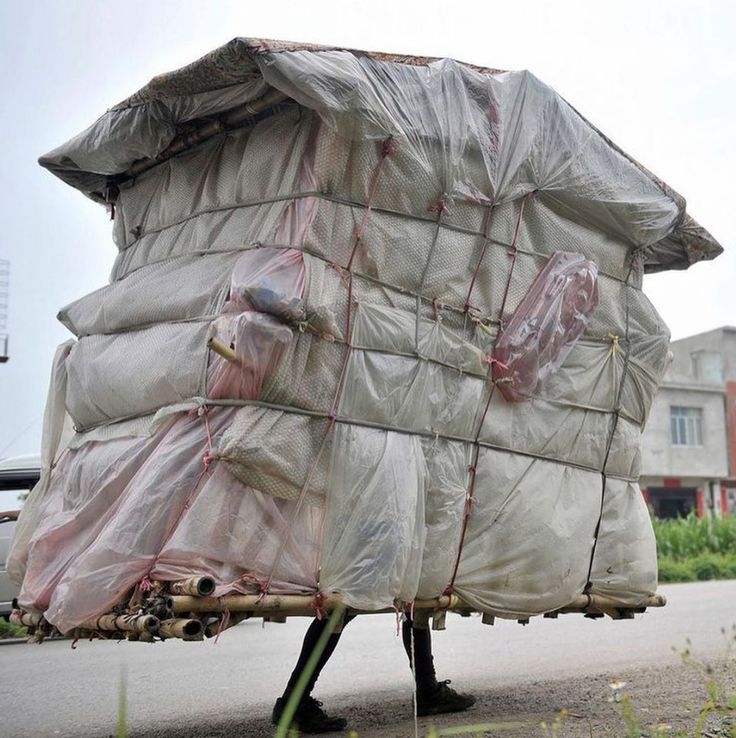
Image : Liu Lingchao’s portable house, 2013
 A MOMENT OF ETERNAL NOISE