Back in the corner they insist on calling my workstation, I took my eyes and mind away from the laptop and towards the magnolia ceiling and slowly, like all proper business people do, started sinking into my fabric office chair way more than the 1990s foam was designed for. With a plastic creak I imagined resting on a beautiful beige bed made from thousands of scrunched-up pages, spilled from an overzealous printer, all these smudged correspondences like forgotten charcoal on a cave wall, intersecting, becoming a sea of adverts, scribbles, demands and staff updates.
Jumbled together, I imagined them, wished for them to be an ocean of warm paper, maybe something like a sea in a children’s theatre production. I was wishing not to drift away on these grey waves but to make something from the experience, to put that interlocking pattern onto a wall, for that wall to come alive, to make an artwork of some kind.
Now, as I think about it, I wonder if all art making is just nostalgic wish fulfilment. We take a probably not always very enjoyable experience and make it real, make it what we wish it was like. I remember passing a note to an artist, Darren Bader, at a particularly boring art dinner; it referenced the guests surrounding us. It said, “all artists just make work about their own insecurities.”
This is of course best in film, when you get to restage your fantasy for real, well, sort of for real, as real as an entirely staged and manicured illusion can be, which is of course ironic: that the art form we connect most with life is the one most distanced from it. Film is, as I often like to say at the water cooler, the most insipid, most manicured of all the arts; it’s the ultimate illusion, designed only to deceive. It is the best magician money can possibly buy and our brains love putting it into the service of creating real-world comparisons. Surely our lives should be more like this light show?
A favourite example of wish fulfilment is Richard Curtis’s experience. He was at a wedding and met an American woman; they connected immediately, but he didn’t talk to her and had to leave. He never saw her again, but instead wrote Four Weddings and a Funeral. So a film that probably encouraged more romantic connections at weddings than any other movie was born from what was essentially insecurity that led to a small regret, followed by an imaginative train of thought.
In Suite Vénitienne, Sophie Calle famously followed a stranger from a party all the way to Venice and documented his movements, his clothes, her experiences. There wasn’t yearning here so much as a sense of documenting yearning, a sentimental, forgotten yearning, trying to recreate a collective idea of what yearning is. Both seem to begin with a gap, something missing, a person disappearing from view, and then the imagination stepping in to continue the story.
I remember a girlfriend telling me, while we sat on a couch watching Dekalog, a Kieslowski series about characters who all lived in a skyscraper, a story about my favourite Kieslowski film, Three Colours Red. She remarked that he once saw a lawyer carrying a simple red bag with a tatty leather handle, a bag like all other bags, and imagined what was inside and whether that document could change someone’s fate. He loved tiny, everyday decisions that could carry unintended moral weight.
He was a Catholic and you can, in my opinion, feel what some would call a spiritual weight when you watch his work (or listen to his composer Zbigniew Preisner); it feels authentic, if a touch pompous. I wondered if his detailing of lives that hinged on precarious moments came from some kind of memory of the war. These moments of inspiration seemed to suggest: maybe if that child had got on a different train, if that bullet had been two inches to the left, then maybe that person would never have had the child that killed the man that made the rocket.
The buzz of the printer continues reassuringly, the noise comfortably locating itself in a history I was never really part of. As I watch without any interest or investment of energy, the ink starts to run out, streaks spreading across the page. I pick one sheet out of the pile. I read the message: a pathetic ChatGPT construction concerning the difference between staff and guest tea bags. I have to tape this up in several kitchenettes across the concrete metropolis that is the hot-desking building circumstances have forced me to work in. I think to myself: which part of me wished for this? Did a thought accidentally manifest itself while I was sitting on the number 10, daydreaming of a life other than art after a private view? A thought like a fart, a thought-fart that, as the book The Secret would suggest, I accidentally made into my reality. It escaped and the demons of wish fulfilment made it happen. I wonder if maybe I need to fart more ambitiously.
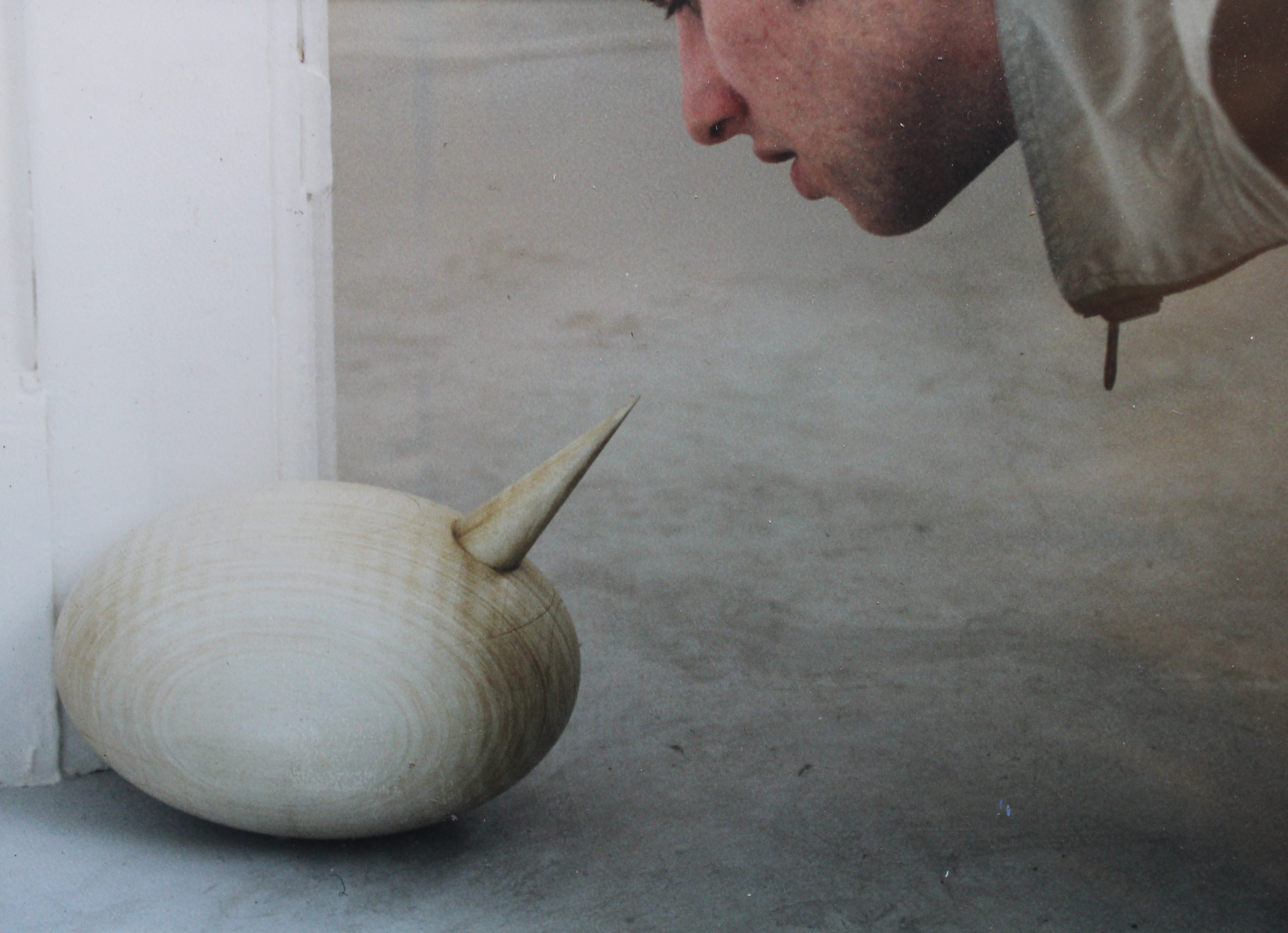
Image : Richard Nik Evans, Speech Bubble, 3D printed speech bubble made from over a thousand sheets of paper, Chelsea College of Art, 2000