Archives for posts with tag: Books

I recently had to come back home, to a village which is now only really known for one person — Nick Drake. I’m now two decades older than he was when he died, so I have definitely spent more time in that tiny village than he ever did. I went to school there, lived down the road, played tennis there. I sat on the steps beneath the village green cross and smoked weed — much like him. In the summer months there’s little better than getting a pint of ale and stretching out on the green, sinking into the buttercups and thinking about absolutely nothing — which, to be honest, he must also have done.

It wasn’t until my early twenties that I even knew he came from Tanworth-in-Arden. It takes a while for the brain to build up enough courage to properly experience sentimentality. For a brief moment back then, I wished I had experienced Tanworth in the 60s, gone to Oxford, drifted around with the band Fairport Convention and quietly disappeared. One of the things about his life is the banality of it; nothing really seems to have happened, and yet the world’s woes seem to pour out of it. It is certainly intriguing, and judging by his Reddit page, people still pour over every lyric and every detail in every photo.

Tanworth, for me, was a place of emptiness — and from that, a place of escapism. I wanted to leave, to finish school, to make things. Theoretically, the area carries all this cultural weight — the Pre-Raphaelites, fragments of English poetry, W. H. Auden, Philip Larkin, later the mythologised countryside of bands like Led Zeppelin and Birmingham bands like Black Sabbath or Steel Pulse — but in reality it was just another commuter-belt village, giving white-collar workers from Birmingham, Coventry and Solihull a kind of mini-castle in the country.

Historically it wasn’t empty at all. This is the Forest of Arden — Shakespeare’s Arden — As You Like It, and that line, “Now I am in Arden, the more fool I”, which always stuck out to me, being the fool in Arden that I am. A place that was once imagined as wild, magical and disorienting has slowly been flattened into something pastel green and off-white. But what I always wondered was what lay beneath the manicured lawns — perhaps a darkness. There is definitely darkness present in Drake’s work. In Riverman, for me, there’s a circular string arrangement based on Delius; at the end of the simple chord progression, the simple move from E inside a C major to E flat immediately draws a curtain across the open window. It’s as dark as anything Sabbath wrote – spiritually speaking.

My grandparents lived there too, just down the road — everything is “just down the road” in those villages. A web of places populated by a post-war generation who worked in Birmingham: factory workers, managers, owners. A few stops on the train and you were in Birmingham, which had once been the second richest industrial city in the UK until the industrial decline in the 60s and 70s.

That relationship — between the pastoral and the industrial — always sits slightly awkwardly, or strangely, within me. As illustrated by another Midland icon — J. R. R. Tolkien. The dichotomy in his work becomes moral: countryside good, industry bad. But in reality it doesn’t work like that. The countryside here wasn’t separate from industry; it was built on top of it. The “heaven” paid for by the “hell”.

My grandmother’s house sat in a large wood and, less romantically, right next to a golf club. It was built in a strange, almost meta way in the grounds of their previous house, and my grandfather filmed the whole thing, shown in the film above. After the war, before golf took over, he was obsessed with a Bolex camera. He shot, edited and directed everything himself. I sometimes think that, given the chance, he might have gone into film instead of making steel screws.

A path ran from the house to the golf club, cutting through one of the remaining fragments of the Forest of Arden. On either side were linden and oak trees. What I remember is the light — sunlight caught on these broad, semi-transparent green leaves, like open palms. It felt like being inside something architectural, like a church that’s bigger on the inside than the outside. It made me wonder if churches had borrowed from forests — trunks becoming columns, branches becoming beams, the steeple like in a nursery rhyme rising out of interlocked hands.

Halfway along that path, high up, there was a treehouse — a box perched and camouflaged in the highest branches. My uncle built it. He had a terrible car crash, almost died, and suffered serious injuries. Later, and according to my mother closely related to this, he became an alcoholic and died from that just a few years ago. Towards the end there were stories — empty vodka bottles hidden in bushes and behind trees. It became gossip, the kind of thing that floats around but isn’t looked at directly. I didn’t really take it in until he was found dead in his front room.

I remember a midsummer evening when I was about fourteen. My grandmother told me it was the longest day of the year. I found that completely mind-blowing — how could someone possibly know that just by looking at a tree? It never occurred to me until much later that she’d probably just heard it on Radio 4 that morning.

That night, in front of the ever-blazing fire (summer and winter) in her 1960s modernist house sunk into the trees, I started looking more closely at everything. The furnishings all seemed to lean into the environment — green carpets like moss, heavy green curtains, parquet floors, probably sourced from some deforested part of the world and then placed back into a version of nature that felt controlled, aesthetic — the outdated aesthetic that shaped my memories and now somehow underlies my work.

The house hadn’t been touched since the 70s. It was full of strange pockets of time — tourist plates, childhood books from the 20s, balls of string, and vintage electrical equipment like torches and binoculars from the war. The binoculars now sit on my bookshelf — not as objects, but for what they might have seen. The place felt like a series of wormholes into 70s aesthetics, a lost and forgotten moodboard, with shelves of tourist plates and scattered remnants of earlier lives. These objects often crop up in films, old books and flea markets. The question of how you would ever choose something like that only gains context once you see it in a magazine image in a second-hand bookshop or — most recently for me — when I recognised the psychedelic carpet in Peter Bogdanovich’s film What’s Up, Doc?, set in a San Francisco hotel, made the same year the house was built.

My grandfather was in Burma during the war. He joined in 1939 through the Territorial Army and spent most of the war behind the front lines, clearing up after the fighting. He was buried alive by a mortar explosion at one point, but dug out. He survived it, carried on. He lived in extreme conditions — heat, illness, isolation — something closer to what we later associate with the Vietnam War, but with far less support and more primitive technology.

Nick Drake’s father was also in Burma, in the Royal Engineers. It’s hard not to think about that when listening to his music. However overplayed it’s become, there’s something in it that feels like it is constantly trying to heal something else. In a teenage sense it’s angst, but I suspect it could be related to familial, historical and geographic contexts.

After the war, Birmingham went through a huge economic boom. People made money, bought houses, moved outwards into places like Tanworth. Coventry, nearby, was heavily bombed and then rebuilt quickly in the 50s and 60s — effectively covered over. A clean surface put on top of something that wasn’t really resolved.

For a long time I thought of someone like Anselm Kiefer as exploiting that history — using the war as material. But his work doesn’t smooth anything over. It does the opposite. It leaves it exposed, like an open wound. His repetition of the open wound is a constant reminder. It’s a firm rebuttal to traditional monuments, but it is still the aesthetic of healing — perhaps suggesting that darkness can do just as much as light.

That’s what feels different here. Places like Tanworth feel calm, settled, resolved. But that calm is constructed. It sits on top of something else, something much darker. In the case of Drake, Kiefer and my own experience, it is always the war and its industrial aftermath. Those experiences didn’t disappear — they just became less visible. For a brief moment they were replaced by boom, but unfortunately it was an industrial, polluting boom. So in a way, the escape to the country was away not just from trauma of the war, but also from the trauma of the landscape.

We don’t really connect the music that came after the war in Britain to that inheritance. Before the hedonism of Zeppelin and Sabbath, there must have been a quieter atmosphere — something shaped by silence, by things not fully processed. Music as a kind of indirect expression, rather than something explicit. This was perhaps hinted at by the British folk movement, which never reached the same scale as hard rock.

This tendency to cover things over — to build something calm and coherent on top of something deeply disturbed — may be the heart of the matter. A village, a house, a type of music: a British attitude to trauma.

Nick Drake’s enigma sits at the centre of this. Lying on the village green, half soaked in English bitter, listening to Drake, dreaming of the past. It’s an easy balm to the world’s problems — violins over ruins — but we should be grateful to be here to listen.

After all, there’s a lot of bodies under those ruins.

Video – The Bowley Reels, No.43, Building Desails, 1974. Dir. Leonard Bowley

Nothing impresses me more than watching a person—or even just knowing a person—can do good work calmly and clearly despite all the complex, difficult, and emotional storms around them. Sometimes I wonder if it’s an integral part of some people’s personality—a skill that cannot be learned. The world may be on fire, but this type of person clears a space within the inferno and gets down to it.

As I look out the window, past the Tom Clancy paperbacks and the dying cactus, I think about the famous New York traffic controller with their white gloves, elegantly directing traffic, taking charge of an impossible tangle of aggressive emotions and powerful machines. It’s a cliché often realized as a kind of poetic dance in films, but the metaphor remains. The solid personality, the public face of government administration, the soft arm of the law, keeping the blood pumping through the veins of the city.

I’m sitting in one of London’s remaining ‘real’ cafés, just north of Camden Town, run by an Eastern European grand-dame. She seems to have mothered children into her seventies and, by all accounts, does the table service, coffee making, cooking, and hosting herself. The café is dressed in a palette that presents itself as burgundy whichever way you look. Book covers become burgundy, a painting of a sunset over a Mediterranean town glows with a burgundy haze, all the woodwork, the cheaply upholstered seats, and even the 1970s menu covers—covering menus unchanged since the 70s—are a rough, deep, brown-red. The place is stuck in perpetual dawn, suspended between night and morning.

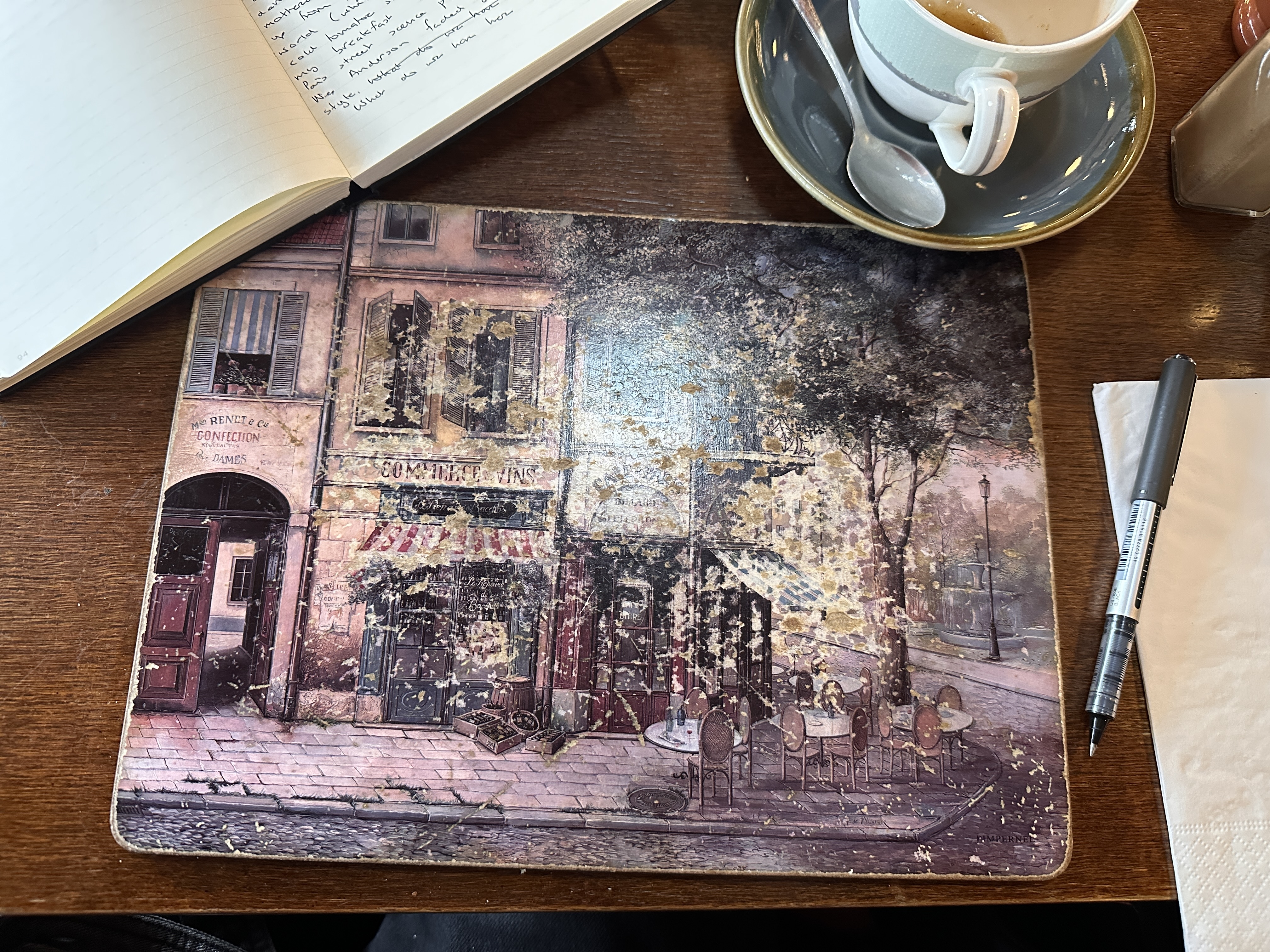
Looking up from possibly the worst poached egg in the world—white bread, watery egg, a lettuce leaf, a cold tomato slice—I notice the mat my breakfast debris rests on. Its pallor contrasts sharply with the dawn (or sunset) implied by the rest of the interior. It depicts a French village street scene in a longing, faded Wes Anderson gouache style, probably painted in the 1980s, worn down by thousands of unsatisfied hands. All the placemats in the café are the same. When I was young, I always wondered why placemats sold together were always identical. Surely that was a missed opportunity. This small, strange experience probably foretold a suspicious relationship to pictures generally: sequential monotony, missed chances to display original art, and so on. I avoid the obvious fantasising about who this anonymous artist is or was.

The image is so faded and worn it is mostly patina—a texture formed through the natural use of the object over its lifetime. The recorded passing of hands, the dents made by cutlery and sauce bottles. Mini rituals, repeated over a lifetime, often feel more important than grand ceremonies dedicated to gods. They are a humble echo of stone steps worn into dips, or sculptures polished by the touch of drunk tourists, but here the ritual is from one mug of tea to the next egg sandwich.

Beyond the chaos of blobs, splats, and spots, the scene appears to be a gently lolling country town, probably in Provence. Probably in the afternoon—at least as most Brits imagine Provence, where time seems to pause around 3pm. The weather is neither sunny nor overcast; it’s just blank. The café’s faded billiards sign reads “Dame Confection” over a slightly dark, suggestive alley. It’s a melancholic pause instigated by a door left ajar. Tables are set outside, awnings stretch overhead, flowerpots on window sills hold upright, alive blooms—or perhaps wooden crafty replicas. Dirty wine glasses squat on the tables, and water cascades over a cake-decoration-style fountain. But unlike my café, the scene is empty, a dead landscape, not a soul around.

The lady of my café begins a long FaceTime call, probably with a friend rather than a relation, as it’s difficult to imagine such patience with family. Four builders come in, followed by another son, then a man, older. The builders order sandwiches while the waitress—owner, cook, and host all in one—pauses between phone nods to take their order. One hand on a child’s head she pivots, ballet-like, into the kitchen. She rests the phone beside the industrial toaster. One hand operates the fear-inducing silver boiling water spout, screaming its high-pitched note as tea mugs are filled. The older man talks to the child; the builders talk to each other. I ask for the bill. Two well-dressed tennis players enter, carrying big bags, striding across the café with impudent gait.

One of the pleasures of being in a café early is watching it fill, each person entering their day in their own arrogant way. Morning, more than any other time, seems to bring out the worst in people. Each feels most important in their world, vying for attention, staking a claim, asserting their right to demand.

The waitress parries the conversations with nobility, deftly progressing through the next ten minutes. I myself raise and lower my first finger, as if to indicate I have somewhere important to go—which I definitely do not. I start thinking seriously about the ‘important’ tasks I have to complete that day. Could she not understand my pressing appointments, the significant artistic contribution I am going to make to humanity?

Five minutes later, I find myself walking up the grey, slimy street toward my flat. The post has arrived: a letter from the taxman asking for another grand. Next door, the builders have started an extension the size of the house itself. No offers for work in the inbox, only time-wasters, desperate emails begging me to review underpants, Amazon delivery updates, and gallery responses that misunderstand my original messages—it all amounts to an anxious, 21st-century irritation. Balancing on top of this mound of faeces, how am I to start drawing? How can I put it all aside to begin something that earns no money, takes time, and is difficult?

Rather than face it, I pick up my phone and look at the last picture I took: the placemat, the mottled empty street. At the back, a tiny stick figure stands with a rectangular object in front of them. It can only be one thing—the artist, sitting calmly in his storm, zen-like, ignoring the torrent of brown bruises around him. Unaware of the ugly marks, he carries on with total clarity. A true plein-air painter. Strangely, I had never considered that plein-air painting might actually be difficult—with the weather, the people asking irritating questions, the performance aspect—but here he is, patient, organized, and focused, possibly painting the very scene depicted on the placemat—the scene now firmly imprinted in my memory.

IMG_954823Mk2


.
We got married at the City Hall, and then we went to the beach. She looked so pretty I just wanted to play in the sand with her, but she had this little smile on her face, and after a while she got up and went down to the surf.

      “I’m going out.”

      She went ahead, and I swam after her. She kept on going, and went a lot further out than she had before. Then she stopped, and I caught up with her. She swung up beside me, and took hold of my hand, and we looked at each other. She knew, then, that the devil was gone, that I loved her.

      “Did I ever tell you why I like my feet to the swells?”

      “It’s so they’ll lift them.”

      A big one raised us up, and she put her hand to her breasts, to show how it lifted them. “I love it. Are they big, Frank?”

      “I’ll tell you tonight.”

      “They feel big. I didn’t tell you about that. It’s not only knowing you’re going to make another life. ”

“It’s what it does to you. My breasts feel so big, and I want you to kiss them. Pretty soon my belly is going to get big, and I’ll love that, and want everybody to see it. It’s life. I can feel it in me. It’s a new life for us both, Frank.”

      We started back, and on the way in I swam down. I went down nine feet. I could tell it was nine feet, by the pressure. Most of these pools are nine feet, and it was that deep. I whipped my legs together and shot down further. It drove in on my ears so I thought they would pop. But I didn’t have to come up. The pressure on your lungs drives the oxygen in your blood, so for a few seconds you don’t think about breath. I looked at the green water. And with my ears ringing and that weight on my back and chest, it seemed to me that all the devilment, and meanness, and shiftlessness, and no-account stuff in my life had been pressed out and washed off, and I was all ready to start out with her again clean, and do like she said, have a new life.”

When I came up she was coughing. “Just one of those sick spells, like you have.”

      “Are you all right?”

      “I think so. It comes over you, and then it goes.”

      “Did you swallow any water?”

      “No.”

      We went a little way, and then she stopped. “Frank, I feel funny inside.”

      “Here, hold on to me.”

      “Oh, Frank. Maybe I strained myself, just then. Trying to keep my head up. So I wouldn’t gulp down the salt water.”

      “Take it easy.”

      “Wouldn’t that be awful? I’ve heard of women that had a miscarriage. From straining theirself.”

      “Take it easy. Lie right out in the water. Don’t try to swim. I’ll tow you in.”

      “Hadn’t you better call a guard?”

      “Christ no. That egg will want to pump your legs up and down. Just lay there now. I’ll get you in quicker than he can.”

      She lay there, and I towed her by the shoulder strap of her bathing suit. I began to give out. I could have towed her a mile, but I kept thinking I had to get her to a hospital, and I hurried. When you hurry in the water you’re sunk. I got bottom, though, after a while, and then I took her in my arms and rushed her through the surf. “Don’t move. Let me do it.”

      “I won’t.”

      I ran with her up to the place where our sweaters were, and set her down. I got the car key out of mine, then wrapped both of them around her and carried her up to the car. It was up beside the road, and I had to climb the high bank the road was on, above the beach. My legs were so tired I could hardly lift one after the other, but I didn’t drop her. I put her in the car, started up, and began burning the road.”

      We had gone in swimming a couple of miles above Santa Monica, and there was a hospital down there. I overtook a big truck. It had a sign on the back, Sound Your Horn, the Road Is Yours. I banged on the horn, and it kept right down the middle. I couldn’t pass on the left, because a whole line of cars was coming toward me. I pulled out to the right and stepped on it. She screamed. I never saw the culvert wall. There was a crash, and everything went black.

      When I came out of it I was wedged down beside the wheel, with my back to the front of the car, but I began to moan from the awfulness of what I heard. It was like rain on a tin roof, but that wasn’t it. It was her blood, pouring down on the hood, where she went through the windshield. Horns were blowing, and people were jumping out of cars and running to her. I got her up, and tried to stop the blood and in between I was talking to her, and crying, and kissing her. Those kisses never reached her. She was dead.

Text: Excerpt from The Postman Always Rings Twice by James M.Cain

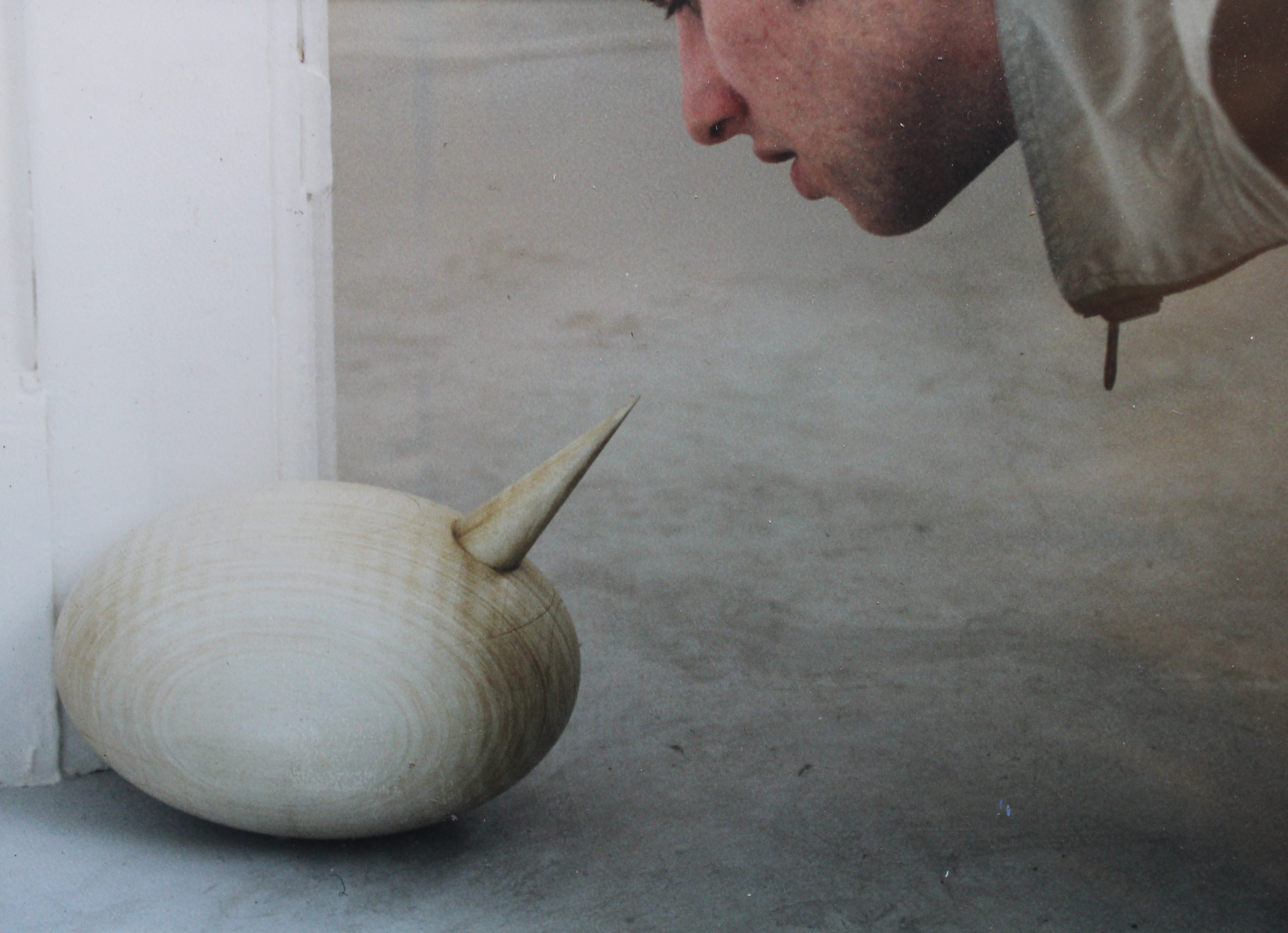
Image : Found photographs with the poster ‘Climax’ from Wespak Visual Communications, San Francisco, 1968. 

Sound: Starless and Bible Black – The Stan Tracey Quartet : Under Milk Wood – Dylan Thomas read by Richard Burton : Jesus’ Blood Never Failed me Yet – Gavin Bryas : Watch Chimes – Ennio Morricone : Requiem For the Russian Tea Room – Primal Scream : Violence – Andy Scott : Clear – Pam Aronoff : Double Connection – Plaster : Diamorphoses – Iannis Xenakis : Michael Jackson – Negavitland : Children of the Night sample – Bela Lugosi : Heavy Lead – Dave Richmond : Dr.No The Lair sample : 6 O’Clock – Zu + Eugene S.Robinson : Burning – Glaxo Babies : Mauvais Sang the Radio sample – Denis Levant : Modern Love – David Bowie : Oriundi – Frida Boccara : Clock – Elements of Noise : Kiss Me Deadly sample : A Warm Place – Trent Reznor