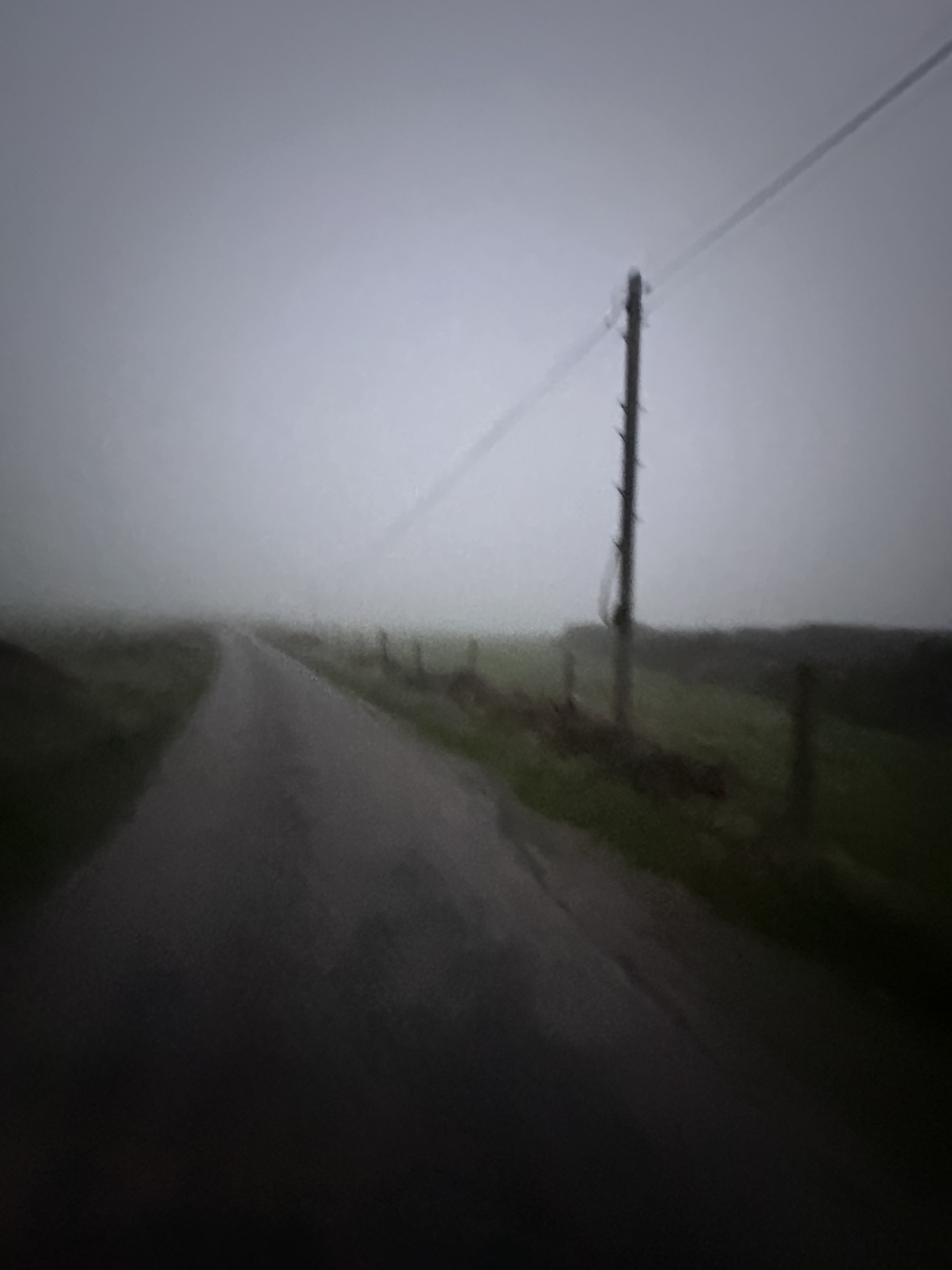
Have you ever found yourself talking about Keats at two o’clock in the morning, high on cocaine, often focusing on just a single line? Which is ironic because I only know a single ‘line’ of Keats. This is where I found myself last night, at a party in a mill in the middle of Cornwall, a patch of land so distanced from a main road it felt like an island in the middle of a green ocean.
The duality in the feeling of two am is often a clean cut, unlike the coke. It lives in a duality. It is both pure and honest and utterly filtered and toxic. Toxic from the stimulants running around your brain, pushed around your system by nicotine and white wine. But in these moments, as you can hear in the background, there is a funny cacophony of bragging, flexing, discussion and yes, honesty. Not many words are said about how bonding cocaine is. It connects people, often strangers, and even in the grim light of the morning they deny to themselves that any real emotional connection was made. In fact, ironically, a lack of emotional connection when you’re doing it is what terrifies me about the drug. I feel that quickly after the first ‘line’ my emotions start running in a completely different direction to my mouth. It disconnects you from the controlling, self-guarding influence of your emotional personality and lets loose the dragon of hidden anxieties and private worries. You are torn in all these different directions.
Keats died in Rome and for a brief time I lived next to his house in Hampstead. I would take artists there as a sort of thing to do. Everyone is ‘sort of interested in Keats’. On his grave is written, and it is the only line I can remember, “Here lies One whose Name was writ in Water.” This was the line I was debating at around 2.30am, boring the dulled tits off anyone who would listen. And now, thinking back, I realise I’m not particularly interested in Keats. I’m just interested in this line, this line he wrote himself as he lay dying. Does it get any more romantic than writing your own gravestone?
And what about that stone? A line that declares our fragile, transitory existence, a finger tracing a name in water, instants disappearing as it passes through this transparent matter, frozen in words using the most permanent of materials. I suppose that’s what gravestones are, signifiers of permanence. Unmovable, site-specific artworks, a bizarre attempt at pretending we do not disappear, even though the stone presides over the rotting corpse beneath it. The contradiction is obvious. The body decomposes, sinking into the dirt, or for some, burnt, ash drifting away into the ether and, in the past, possibly even washed into the gutter. We become part of the environment, returning to the material world from which we came, eventually finding our way into the water that already makes up so much of our bodies. Or was Keats talking about something else, the fleeting experience of fame, the fickle light of success passing so quickly, like a name moving through society, famous for a second then forgotten? He died believing he had failed to make any dent in the world of literature. It’s an extraordinary irony that we now remember him through the very words he chose to describe his own disappearance.
Keats also invented, or labelled, the concept of Negative Capability, which is about suspending judgement in order to learn more about something. If that is not a great party skill, I don’t know what is. It encourages curiosity over labels, and that very contemporary action, ‘listening’. The term appeared in a letter to his brothers and was about immersing oneself in “uncertainties, mysteries, doubts, without any irritable reaching after fact and reason.” He was writing about Shakespeare. Was this therefore a response to not entirely understanding Shakespeare’s work, to allowing it to wash over you rather than immediately trying to make sense of it? Growing up in Stratford-upon-Avon and snoozing my way through the Bard’s entire canon, I feel like I’m an example that learning while asleep is not possible. But perhaps through just experiencing Shakespeare, through ‘living through it’, you learn something. When I was young I used to think Shakespeare was not particularly good, that we were just told he was good. We live in a PR juggernaut, almost every corner of our culture tells us Shakespeare is great, and eventually you end up agreeing with them. Just like you end up agreeing with weekends, work hours and country walks. Perhaps Negative Capability is the ability to resist that agreement for a moment, to allow something to remain uncertain without immediately deciding whether it is good or bad, or whether you like it or not.
The key to enjoying any house party really.
Today, suitably hungover, I was walking through Helston High Street. The main street runs in a straight line up a hill and either side are these tiny streams of water, small canals that in the past must have taken the town’s effluent away, or maybe were used for cleaning the metals taken from Cornish mines. I started thinking about all the nights I’ve been out, all the important conversations that became the foundations of friendships, the plans and schemes never actioned and, of course, with so much regret, the hangovers that swallowed up days of my life. The conversations that seemed so important at the time, the things we said about other people, the things we probably shouldn’t have said, and those fragments of honesty that occasionally surfaced through the noise. All of it passing through us, like the water running alongside the high street, going where, who knows? Some of it comes back the next morning, disconnected fragments poking through the hangover with pangs of tame shame. Other things disappear completely. Perhaps that’s the point. We spend so much of our lives trying to make things permanent, giving names to things, deciding what they mean, judging people and experiences when really we know nothing. We’re just grasping in the darkness. Maybe it would be best just to let it flow through us?
Image : Zennor, Cornwall, October 2026

